
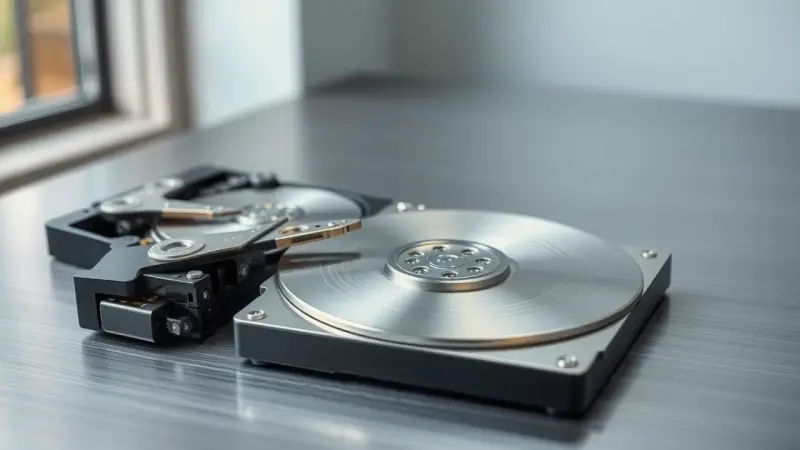
In 2013, Seagate announced that it had sold more than 1 million drives using shingled magnetic recording (SMR). It said the technology would let it offer consumers 5TB hard drives the following year, and possibly 20TB drives by 2020.
The company’s argument was that hard drives were running into a density wall. The data tracks on a 1TB platter could not shrink much further, Seagate said. The theoretical limit of magnetic storage, the superparamagnetic limit, is about 1Tbit per square inch. Pushing density past it risks data corruption. At the time, Seagate’s drives stored data at up to 625Gbits per square inch.
The companies and the technologies
Seagate’s chief technology officer, Mark Re, said in a statement that SMR put the company on track to raise areal density by up to 25%, or 1.25TB per disk. He said this would deliver the lowest cost per gigabyte and capacities of 5TB and beyond. Platters had grown to 1TB by 2013.
Seagate also pointed to demand. It predicted that households generating 1TB of data a month through streaming, photos and music would create 20 times as much within two years. Drive density would have to keep pace.
SMR was only one of several advances in the pipeline. Heat-assisted magnetic recording (HAMR) was expected to take disk drives to 5Tbits per square inch. HAMR heats the medium with a laser-generated beam at the spot where a bit is written.
Seagate’s own HAMR announcement at the CEATEC 2013 show in Tokyo repeated the 20TB-by-2020 target. Seagate said HAMR combined with self-ordered iron-platinum particle arrays could eventually reach as much as 50Tbits per square inch. That would break the limit of magnetic recording by more than a factor of 100, the company claimed.
What happened to the 2020 target
Seagate later described the first SMR hard drive as arriving in 2014. It said that drive improved density by 25 percent, in line with the 2013 claim.
The HAMR timetable moved more than once:
- In 2017, Seagate said pilot volumes of HAMR drives would be available by the end of 2018. It also said 20TB-plus drives would follow in volume by 2019.
- By late 2018, The Register reported, Seagate’s roadmap showed the first HAMR drives in 2020, with a 20TB-plus capacity. The roadmap put the last PMR drive at 16TB in 2019 or 2020.
- In November 2020, Seagate chief executive Dave Mosley told an investment conference that the company would move from its first 20TB HAMR technology to a 24TB drive. He said it would skip an intermediate 22TB step. Blocks and Files and TechRadar reported this.
Western Digital took a different route. It developed microwave-assisted magnetic recording (MAMR) as its alternative to HAMR. Mosley said in 2020 that Seagate knew MAMR well and called it a viable technology, but only a small step forward. He said Seagate believed HAMR was the right path because of its media technology.
Mosley also acknowledged a cost issue. A HAMR drive may cost more to make than a non-HAMR drive of the same capacity, because each head needs a laser heating diode. Seagate planned to use HAMR across much of its range to spread that cost over more drives.
Seagate gave a longer-range view in 2018. It said it could deliver a 48TB drive in 2023 using HAMR, with areal density doubling every 30 months. That pace could make 100TB drives possible by 2025 or 2026, it said.